What is Eurasian watermilfoil and why is it bad?
-
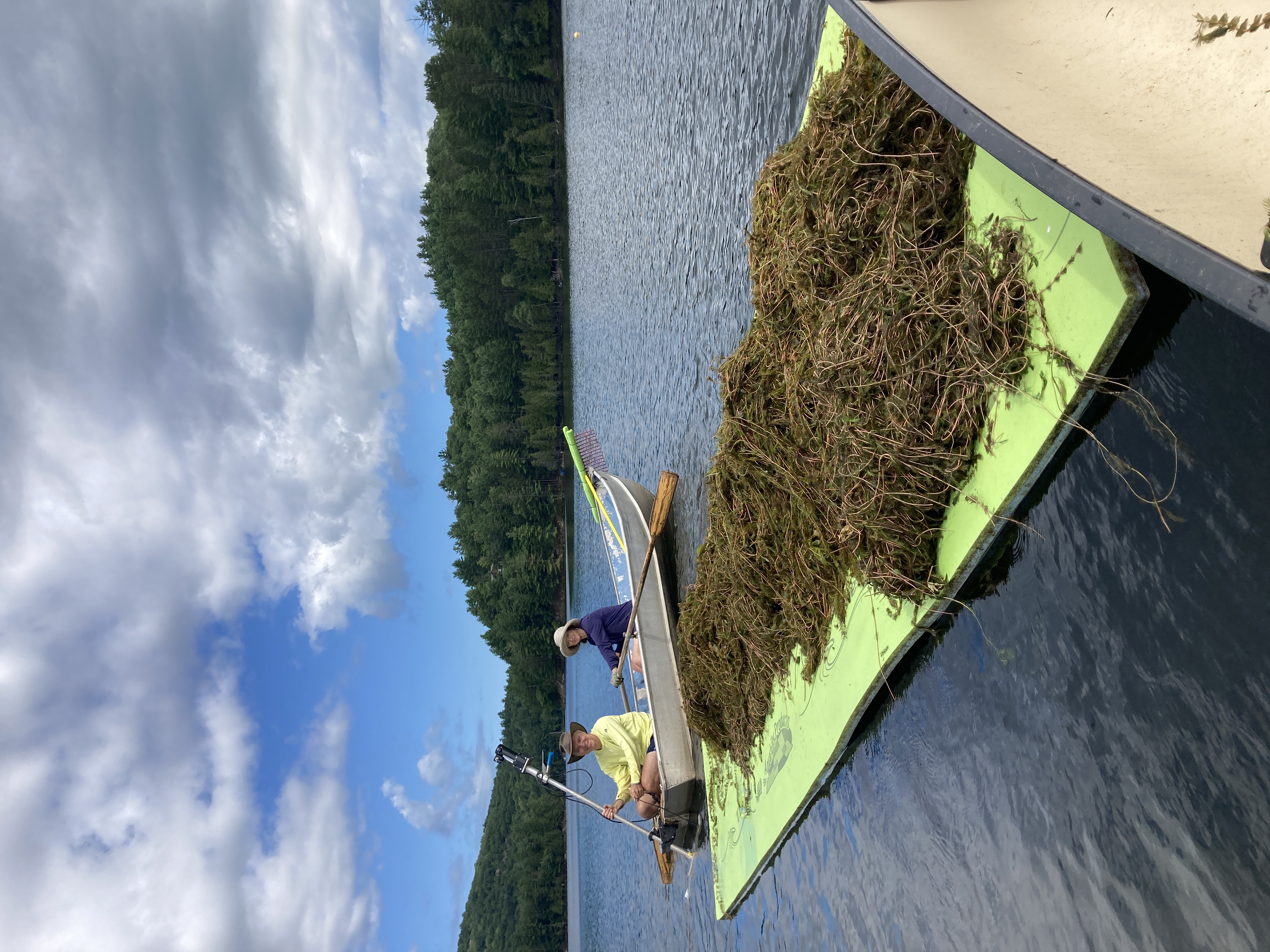
Eurasian watermilfoil, or milfoil for short, is an invasive aquatic plant that generally grows at depths of one to four meters but can take root in depths up to ten meters. It can form dense carpets on the lake’s surface interfering with swimming, fishing, boating and other activities.
-
As the plant dies and decays at the end of each season, it consumes oxygen dissolved in the water. This can negatively affect fish and other wildlife.
-
Milfoil reproduces through the fragmentation of its stems. This occurs naturally from mid-July to October, but it can also be drastically worsened by nautical activities which are known to be a significant cause of milfoil spread.
-
Milfoil outcompetes native plants for nutrients and over time can overtake most if not all natural aquatic vegetation.
-
Eurasian watermilfoil is estimated to have arrived in Lac Notre-Dame in 1994. Most likely the plant was first deposited in the lake by a boat or trailer carrying a small fragment of the weed.
-
The first attempt to map the plant in 2004 found a small number of isolated beds in shallow areas of the lake. Ten years later, in 2014, the consulting group ABV7 (Agence de bassin versant des 7) found the hearty milfoil plant had spread to more than 25% of the lake. Read the AVB7 report here.
-
Despite control efforts, milfoil can now be found in most shallow areas of the lake.
-
Eurasian watermilfoil does not die when it is cut or pulled from the lake bottom. Instead, cuttings left in the water often grow into new plants.
-
The amount of milfoil in the water can vary from year to year, depending on the weather and other factors that affect the plant’s growth.
-
The Lake Association was founded in 2004 in response to the Eurasian watermilfoil explosion in the lakes. The Association received valued advice and assistance from biologist Paul Hamilton of the Canadian Museum of Nature. Mr. Hamilton continues to support the Association’s efforts by analyzing water test results and advising us about important changes in the water quality.
-
An electric cutter was purchased before 2008 by the Association, with a financial contribution of $6,400 from the Municipality of La Pêche. While the cutter was put to use initially, it was soon found to be impractical. Furthermore, provincial regulations today prohibit cutting of the milfoil.
-
A survey of residents in June 2025 found a high level of concern about milfoil’s impact on laker users and the environment.